
Cold Weather Alert: Learn How to Protect your Chemistry
WINTER REALITY CHECK
Key point: Winter failures often show up weeks or months later — which is exactly why they get misdiagnosed as “product problems” when they’re actually chemistry problems.
1) Cold Changes Chemistry (Not Just Dry Time)
Every coating system is engineered to react within a specific temperature window. When you spray in cold conditions, multiple things happen at once:
- Solvents evaporate slower
- Crosslinking reactions slow down
- Resins don’t flow or level properly
- Pigments and solids don’t orient correctly
- Adhesion promoters don’t chemically activate
- Moisture contamination becomes a real risk
This leads to:
Downglossing Hazing Blushing Fish Eyes Soft Films Poor Adhesion Delayed Cure Edge Failures Long-Term Chalking
Danger: You may not see these failures immediately. Winter failures often show up weeks or months later.
2) Waterbase Products Are Especially Vulnerable
Waterbase coatings, primers, cleaners, and additives are extremely sensitive to freezing. Once a waterbase product freezes:
- Emulsions can break
- Polymers can coagulate
- Additives can separate
- Performance is permanently compromised
Rule of thumb: If a waterbase product ever freezes → consider it damaged (even if it “looks fine” after thawing).
Hidden winter loss: guys spraying product that has already been chemically destroyed.
3) Storage: Your Truck Is Not a Warehouse
In winter, your materials are riding in: uninsulated vans, box trucks, trailers, and pickup beds. Overnight temperatures can easily destroy product.
Professional storage rules:
- Never leave coatings in the vehicle overnight
- Store in heated indoor space whenever possible
- Use insulated storage bins
- Use coolers/ice chests as thermal buffers
- Use moving blankets or heat blankets
- Keep waterbase products inside your house or shop
Your coatings should be stored between: 65°F – 75°F (18°C – 24°C) whenever possible.
4) Pre-Warming Materials (A Pro Trick)
Before winter jobs, professionals pre-warm: coatings, primers, reducers, additives, spray guns, and hoses.
Methods that actually work:
- Keep materials in a heated room overnight
- Use insulated coolers with heat packs
- Use electric heat blankets
- Warm bottles in a sink of warm water
- Bring materials inside the client’s house 30–60 minutes early
Never spray ice-cold material. Cold material = thick viscosity + bad atomization + poor leveling. You are literally fighting physics.
5) Cold Surfaces Are the Silent Killer
Cast iron and steel tubs in older homes (especially military housing) are often exposed underneath, sitting in cold crawlspaces, acting like heat sinks. So even if the bathroom feels warm, the actual tub surface may be 40–50°F.
That causes:
- Instant solvent chill
- Condensation
- Flash-off problems
- Adhesion failures
You’re spraying warm chemistry onto a cold piece of metal. The surface wins every time.
6) Pro Field Trick: Use Your Turbine as a Heater
Before spraying:
- Turn on your hot-air turbine
- Tape the hose over the tub apron
- Let it run 15–20 minutes
- Heat the surface directly
This does two critical things: raises substrate temperature and drives off moisture/condensation. You are literally pre-conditioning the chemistry zone.
Reality: This single trick prevents more winter failures than almost anything else.
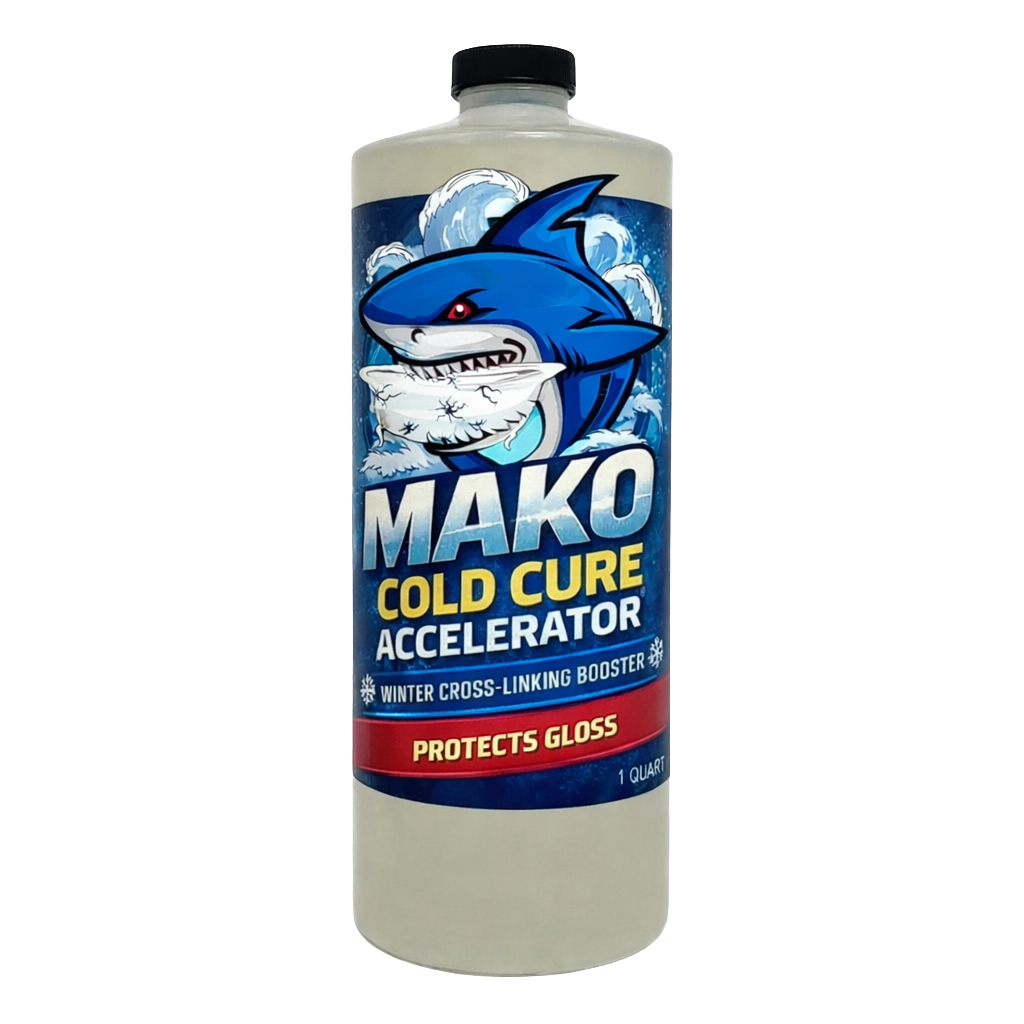
8) When to Use MAKO
Use MAKO when:
- Ambient temps are below 70°F
- Substrate feels cold to the touch
- Working in winter climates
- Working in unheated homes
- Spraying cast iron or steel tubs
- Working in basements or crawlspace houses
MAKO allows your urethane to behave like it’s spraying in perfect summer conditions — even when it’s not.
9) Spray Technique in Cold Weather
In winter, you must adjust technique:
- Lighter coats
- More flash time between passes
- Less fluid output
- Slightly closer gun control
- Avoid flooding cold surfaces
- Avoid over-reducing
Cold slows evaporation. Over-wet coats in winter = runs, solvent entrapment, hazing.
10) Thinning and Reducing in Winter
Do not automatically add more reducer just because it’s cold. Cold material is already thick.
Over-reducing leads to:
- Weak film build
- Transparency
- Loss of gloss
- Poor durability
Better solution: Warm the material and use MAKO — not more solvent.
11) Humidity + Cold = Blushing Risk
Cold air holds less moisture. But warm, humid bathrooms hitting cold tubs = instant condensation.
Always:
- Preheat the tub
- Preheat the room
- Vent moisture
- Avoid spraying on cold, damp surfaces
Blushing is not a product problem. It’s a temperature + moisture problem.
The SharkGrip Winter Rule
If you control four things, winter becomes a non-issue:
- Material temperature
- Surface temperature
- Air temperature
- Chemical energy (MAKO)
Miss any one — your chemistry suffers.
Final Thought
Cold doesn’t just slow your job. Cold rewrites the rules of chemistry.
Professionals don’t fight winter with hope. They fight it with: heat, planning, proper storage, surface conditioning, controlled technique, and the right chemistry.
That’s the difference between:
“I spray in winter” “I make money in winter.”
Stay warm. Protect your chemistry. Protect your reputation.
Professionals don’t fight winter with hope. They fight it with: heat, planning, proper storage, surface conditioning, controlled technique, and the right chemistry.
That’s the difference between:
“I spray in winter” “I make money in winter.”
Stay warm. Protect your chemistry. Protect your reputation.
— Gary A. Goel
SharkGrip Coatings Support Team
SharkGrip Coatings Support Team
This post is part of the Shark Bites Series • Professional use guidance for trained refinishers.
Jan 26th 2026
Recent Posts
-
Titan Just Moved and We Moved With IT.
Titan Capspray X 115 – Product Walk Around EAH Industrial Exclusive Industry News …Feb 11th 2026 -
Cold Weather Alert: Learn How to Protect your Chemistry
SHARK BITES SERIES • MESSAGE FROM YOUR SUPPORT TEAM Cold Weather Alert: Protect Your Chemistry B …Jan 26th 2026 -
Turbine HVLP Maintenance: The Professional’s Guide to Filters, Airflow & Real Performance
Turbine HVLP Maintenance Keep Your Sprayer Performing Like a System — Not a Guessing Game. Whethe …Jan 24th 2026